Tuesday, October 15, 2013

Saint of the Day - October 16
St. Margaret of Cortona
(1247-1297)


Margaret was born of farming parents in Laviano, Tuscany. Her mother died when Margaret was seven; life with her stepmother was so difficult that Margaret moved out. For nine years she lived with Arsenio, though they were not married, and she bore him a son. In those years, she had doubts about her situation. Somewhat like St. Augustine she prayed for purity—but not just yet.
One day she was waiting for Arsenio and was instead met by his dog. The animal led Margaret into the forest where she found Arsenio murdered. This crime shocked Margaret into a life of penance. She and her son returned to Laviano, where she was not well received by her stepmother. They then went to Cortona, where her son eventually became a friar.
In 1277, three years after her conversion, Margaret became a Franciscan tertiary. Under the direction of her confessor, who sometimes had to order her to moderate her self-denial, she pursued a life of prayer and penance at Cortona. There she established a hospital and founded a congregation of tertiary sisters. The poor and humble Margaret was, like Francis, devoted to the Eucharist and to the passion of Jesus. These devotions fueled her great charity and drew sinners to her for advice and inspiration. She was canonized in 1728.
Saint of the  -  October 15
St. Teresa of Avila
(1515-1582)

Teresa lived in an age of exploration as well as political, social and religious upheaval. It was the 16th century, a time of turmoil and reform. She was born before the Protestant Reformation and died almost 20 years after the closing of the Council of Trent.
The gift of God to Teresa in and through which she became holy and left her mark on the Church and the world is threefold: She was a woman; she was a contemplative; she was an active reformer.
As a woman, Teresa stood on her own two feet, even in the man's world of her time. She was "her own woman," entering the Carmelites despite strong opposition from her father. She is a person wrapped not so much in silence as in mystery. Beautiful, talented, outgoing, adaptable, affectionate, courageous, enthusiastic, she was totally human. Like Jesus, she was a mystery of paradoxes: wise, yet practical; intelligent, yet much in tune with her experience; a mystic, yet an energetic reformer. A holy woman, a womanly woman.

Teresa was a woman "for God," a woman of prayer, discipline and compassion. Her heart belonged to God. Her ongoing conversion was an arduous lifelong struggle, involving ongoing purification and suffering. She was misunderstood, misjudged, opposed in her efforts at reform. Yet she struggled on, courageous and faithful; she struggled with her own mediocrity, her illness, her opposition. And in the midst of all this she clung to God in life and in prayer. Her writings on prayer and contemplation are drawn from her experience: powerful, practical and graceful. A woman of prayer; a woman for God.
Teresa was a woman "for others." Though a contemplative, she spent much of her time and energy seeking to reform herself and the Carmelites, to lead them back to the full observance of the primitive Rule. She founded over a half-dozen new monasteries. She traveled, wrote, fought—always to renew, to reform. In her self, in her prayer, in her life, in her efforts to reform, in all the people she touched, she was a woman for others, a woman who inspired and gave life.
Her writings, especially the Way of Perfection and The Interior Castle, have helped generations of believers.

In 1970, the Church gave her the title she had long held in the popular mind: doctor of the Church. She and St. Catherine of Siena (April 29)were the first women so honored.


Saint of the Day - October 14
St. Callistus I
(d. 223?)

The most reliable information about this saint comes from his enemy St. Hippolytus, an early antipope, later a martyr for the Church. A negative principle is used: If some worse things had happened, Hippolytus would surely have mentioned them.
Callistus was a slave in the imperial Roman household. Put in charge of the bank by his master, he lost the money deposited, fled and was caught. After serving time for a while, he was released to make some attempt to recover the money. Apparently he carried his zeal too far, being arrested for brawling in a Jewish synagogue. This time he was condemned to work in the mines of Sardinia. He was released through the influence of the emperor's mistress and lived at Anzio (site of a famous World War II beachhead).
After winning his freedom, Callistus was made superintendent of the public Christian burial ground in Rome (still called the cemetery of St. Callistus), probably the first land owned by the Church. The pope ordained him a deacon and made him his friend and adviser.
He was elected pope by a majority vote of the clergy and laity of Rome, and thereafter was bitterly attacked by the losing candidate, St. Hippolytus, who let himself be set up as the first antipope in the history of the Church. The schism lasted about 18 years.
Hippolytus is venerated as a saint. He was banished during the persecution of 235 and was reconciled to the Church. He died from his sufferings in Sardinia. He attacked Callistus on two fronts—doctrine and discipline. Hippolytus seems to have exaggerated the distinction between Father and Son (almost making two gods) possibly because theological language had not yet been refined. He also accused Callistus of being too lenient, for reasons we may find surprising: (1) Callistus admitted to Holy Communion those who had already done public penance for murder, adultery, fornication; (2) he held marriages between free women and slaves to be valid—contrary to Roman law; (3) he authorized the ordination of men who had been married two or three times; (4) he held that mortal sin was not a sufficient reason to depose a bishop; (5) he held to a policy of leniency toward those who had temporarily denied their faith during persecution.
Callistus was martyred during a local disturbance in Trastevere, Rome, and is the first pope (except for Peter) to be commemorated as a martyr in the earliest martyrology of the Church.

Saturday, October 12, 2013

Saint of the Day - October 12
St. Seraphin of Montegranaro

(1540-1604)


Born into a poor Italian family, young Seraphin lived the life of a shepherd and spent much of his time in prayer. Mistreated for a time by his older brother after the two of them had been orphaned, Seraphin became a Capuchin Franciscan at age 16 and impressed everyone with his humility and generosity.
Serving as a lay brother, Seraphin imitated St. Francis in fasting, clothing and courtesy to all. He even mirrored Francis' missionary zeal, but Seraphin's superiors did not judge him to be a candidate for the missions.
Faithful to the core, Seraphin spent three hours in prayer before the Blessed Sacrament daily. The poor who begged at the friary door came to hold a special love for him. Despite his uneventful life, he reached impressive spiritual heights and has had miracles attributed to him.

Seraphin died on October 12, 1604, and was canonized in 1767.

Wednesday, October 9, 2013


Saint of the Day - October 10th
St. Francis Borgia
(1510-1572)


Today's saint grew up in an important family in 16th-century Spain, serving in the imperial court and quickly advancing in his career. But a series of events—including the death of his beloved wife—made Francis Borgia rethink his priorities. He gave up public life, gave away his possessions and joined the new and little-known Society of Jesus.
Religious life proved to be the right choice. He felt drawn to spend time in seclusion and prayer, but his administrative talents also made him a natural for other tasks. He helped in the establishment of what is now the Gregorian University in Rome. Not long after his ordination he served as political and spiritual adviser to the emperor. In Spain, he founded a dozen colleges.
At 55, Francis was elected head of the Jesuits. He focused on the growth of the Society of Jesus, the spiritual preparation of its new members and spreading the faith in many parts of Europe. He was responsible for the founding of Jesuit missions in Florida, Mexico and Peru.

Francis Borgia is often regarded as the second founder of the Jesuits. He died in 1572 and was canonized 100 years later.

Tuesday, October 8, 2013

Saint of the Day - October 9
St. John Leonardi


"I am only one person! Why should I do anything? What good would it do?" Today, as in any age, people seem plagued with the dilemma of getting involved. In his own way John Leonardi answered these questions. He chose to become a priest.
After his ordination, he became very active in the works of the ministry, especially in hospitals and prisons. The example and dedication of his work attracted several young laymen who began to assist him. They later became priests themselves.
John lived after the Protestant Reformation and the Council of Trent (1545-63). He and his followers projected a new congregation of diocesan priests. For some reason the plan, which was ultimately approved, provoked great political opposition. John was exiled from his home town of Lucca, Italy, for almost the entire remainder of his life. He received encouragement and help from St. Philip Neri [whose feast is May 26], who gave him his lodgings—along with the care of his cat!
In 1579, John formed the Confraternity of Christian Doctrine, and published a compendium of Christian doctrine that remained in use until the 19th century.
Father Leonardi and his priests became a great power for good in Italy, and their congregation was confirmed by Pope Clement in 1595. He died at the age of 68 from a disease caught when tending those stricken by the plague.

By the deliberate policy of the founder, the Clerks Regular of the Mother of God have never had more than 15 churches and today form only a very small congregation.

Monday, October 7, 2013

Saint of the day - 8 th October 
St. Pelagia


Pelagia, more often called Margaret, on account of the magnificence of the pearls for which she had so often sold herself, was an actress of Antioch, equally celebrated for her beauty, her wealth and the disorder ofher life.  During a synod at Antioch, she passed Bishop St. Nonnus of Edessa, who was struck with her beauty; the next day she went to hear him preach and was so moved by his sermon that she asked him to baptize her which he did. She gave her wealth to Nonnus to aid the poor and left Antioch dressed in men's clothing. She became a hermitess in a cave on Mount of Olivette in Jerusalem, where she lived in great austerity, performing penances and known as "the beardless monk" until her sex was discovered at her death. Though a young girl of fifteen did exist and suffer martyrdom at Antioch in the fourth century, the story heretold is a pious fiction, which gave rise to a whole set of similar stories under different names. Her feast day is October 8th.  

Sunday, October 6, 2013

Saint of the day - October 7
Our Lady of the Rosary

St. Pius V (April 30) established this feast in 1573. The purpose was to thank God for the victory of Christians over the Turks at Lepanto—a victory attributed to the praying of the rosary. Clement XI extended the feast to the universal Church in 1716.
The development of the rosary has a long history. First, a practice developed of praying 150 Our Fathers in imitation of the 150 Psalms. Then there was a parallel practice of praying 150 Hail Marys. Soon a mystery of Jesus' life was attached to each Hail Mary. Though Mary's giving the rosary to St. Dominic is recognized as a legend, the development of this prayer form owes much to the followers of St. Dominic. One of them, Alan de la Roche, was known as "the apostle of the rosary." He founded the first Confraternity of the Rosary in the 15th century. In the 16th century the rosary was developed to its present form—with the 15 mysteries (joyful, sorrowful and glorious). In 2002, Pope John Paul II added five Mysteries of Light to this devotion.

Saturday, October 5, 2013

Saint of the Day - October 6
St. Bruno

Bruno was born in Cologne, Germany, became a famous teacher at Rheims and was appointed chancellor of the archdiocese at the age of 45. He supported Pope Gregory VII (May 25) in his fight against the decadence of the clergy and took part in the removal of his own scandalous archbishop, Manasses. Bruno suffered the plundering of his house for his pains.
He had a dream of living in solitude and prayer, and persuaded a few friends to join him in a hermitage. After a while he felt the place unsuitable and, through a friend, was given some land which was to become famous for his foundation "in the Chartreuse" (from which comes the word Carthusians). The climate, desert, mountainous terrain and inaccessibility guaranteed silence, poverty and small numbers.
Bruno and his friends built an oratory with small individual cells at a distance from each other. They met for Matins and Vespers each day and spent the rest of the time in solitude, eating together only on great feasts. Their chief work was copying manuscripts.
The pope, hearing of Bruno's holiness, called for his assistance in Rome. When the pope had to flee Rome, Bruno pulled up stakes again, and spent his last years (after refusing a bishopric) in the wilderness of Calabria.
He was never formally canonized, because the Carthusians were averse to all occasions of publicity. Pope Clement extended his feast to the whole Church in 1674.

Friday, October 4, 2013

Saint of the Day -October 5
Blessed Francis Xavier Seelos(1819-1867)


Zeal as a preacher and a confessor led Father Seelos to works of compassion as well.

Born in southern Bavaria, he studied philosophy and theology in Munich. On hearing about the work of the Redemptorists among German-speaking Catholics in the United States, he came to this country in 1843. Ordained at the end of 1844, he was assigned for six years to St. Philomena’s Parish in Pittsburgh as an assistant to St. John Neumann [whose feast is observed on January 5]. The next three years Father Seelos was superior in the same community and began his service as novice master.
Several years in parish ministry in Maryland followed, along with responsibility for training Redemptorist students. During the Civil War, he went to Washington, D.C., and appealed to President Lincoln that those students not be drafted for military service.
For several years he preached in English and in German throughout the Midwest and in the Middle Atlantic states. Assigned to St. Mary of the Assumption Church community in New Orleans, he served his Redemptorist confreres and parishioners with great zeal. In 1867 he died of yellow fever, having contracted that disease while visiting the sick. He was beatified in 2000.
St. Maria Faustina Kowalska
(1905-1938)


St. Maria Faustina's name is forever linked to the annual feast of the Divine Mercy (celebrated on the Second Sunday of Easter), the divine mercy chaplet and the divine mercy prayer recited each day by many people at 3 p.m.
Born in what is now west-central Poland (part of Germany before World War I), Helena was the third of 10 children. She worked as a housekeeper in three cities before joining the Congregation of the Sisters of Our Lady of Mercy in 1925. She worked as a cook, gardener and porter in three of their houses.
In addition to carrying out her work faithfully, generously serving the needs of the sisters and the local people, she also had a deep interior life. This included receiving revelations from the Lord Jesus, messages that she recorded in her diary at the request of Christ and of her confessors.
At a time when some Catholics had an image of God as such a strict judge that they might be tempted to despair about the possibility of being forgiven, Jesus chose to emphasize his mercy and forgiveness for sins acknowledged and confessed. “I do not want to punish aching mankind,” he once told St. Maria Faustina, “but I desire to heal it, pressing it to my merciful heart” (Diary 1588). The two rays emanating from Christ's heart, she said, represent the blood and water poured out after Jesus' death (Gospel of John 19:34)
Because Sister Maria Faustina knew that the revelations she had already received did not constitute holiness itself, she wrote in her diary: “Neither graces, nor revelations, nor raptures, nor gifts granted to a soul make it perfect, but rather the intimate union of the soul with God. These gifts are merely ornaments of the soul, but constitute neither its essence nor its perfection. My sanctity and perfection consist in the close union of my will with the will of God” (Diary 1107).

Sister Maria Faustina died of tuberculosis in Krakow, Poland, on October 5, 1938. Pope John Paul II beatified her in 1993 and canonized her seven years later.

Thursday, October 3, 2013

Saint of the Day - October 4
St. Francis of Assisi
(1182-1226)

Francis of Assisi was a poor little man who astounded and inspired the Church by taking the gospel literally—not in a narrow fundamentalist sense, but by actually following all that Jesus said and did, joyfully, without limit and without a sense of self-importance.
Serious illness brought the young Francis to see the emptiness of his frolicking life as leader of Assisi's youth. Prayer—lengthy and difficult—led him to a self-emptying like that of Christ, climaxed by embracing a leper he met on the road. It symbolized his complete obedience to what he had heard in prayer: "Francis! Everything you have loved and desired in the flesh it is your duty to despise and hate, if you wish to know my will. And when you have begun this, all that now seems sweet and lovely to you will become intolerable and bitter, but all that you used to avoid will turn itself to great sweetness and exceeding joy."
From the cross in the neglected field-chapel of San Damiano, Christ told him, "Francis, go out and build up my house, for it is nearly falling down." Francis became the totally poor and humble workman.
He must have suspected a deeper meaning to "build up my house." But he would have been content to be for the rest of his life the poor "nothing" man actually putting brick on brick in abandoned chapels. He gave up all his possessions, piling even his clothes before his earthly father (who was demanding restitution for Francis' "gifts" to the poor) so that he would be totally free to say, "Our Father in heaven." He was, for a time, considered to be a religious fanatic, begging from door to door when he could not get money for his work, evokng sadness or disgust to the hearts of his former friends, ridicule from the unthinking.
But genuineness will tell. A few people began to realize that this man was actually trying to be Christian. He really believed what Jesus said: "Announce the kingdom! Possess no gold or silver or copper in your purses, no traveling bag, no sandals, no staff" (Luke 9:1-3).
Francis' first rule for his followers was a collection of texts from the Gospels. He had no idea of founding an order, but once it began he protected it and accepted all the legal structures needed to support it. His devotion and loyalty to the Church were absolute and highly exemplary at a time when various movements of reform tended to break the Church's unity.
He was torn between a life devoted entirely to prayer and a life of active preaching of the Good News. He decided in favor of the latter, but always returned to solitude when he could. He wanted to be a missionary in Syria or in Africa, but was prevented by shipwreck and illness in both cases. He did try to convert the sultan of Egypt during the Fifth Crusade.
During the last years of his relatively short life (he died at 44), he was half blind and seriously ill. Two years before his death, he received the stigmata, the real and painful wounds of Christ in his hands, feet and side.
On his deathbed, he said over and over again the last addition to his Canticle of the Sun, "Be praised, O Lord, for our Sister Death." He sang Psalm 141, and at the end asked his superior to have his clothes removed when the last hour came and for permission to expire lying naked on the earth, in imitation of his Lord.

Wednesday, October 2, 2013


Saint of the Day - October 3
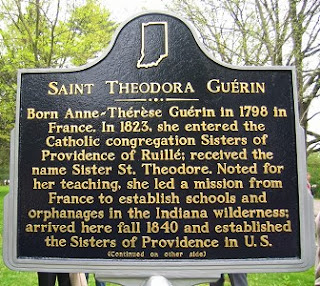
St. Theodora Guérin
(1798-1856)

Trust in God’s Providence enabled Mother Theodore to leave her homeland, sail halfway around the world and to found a new religious congregation.
Born in Etables, France, Anne-Thérèse’s life was shattered by her father’s murder when she was 15. For several years she cared for her mother and younger sister. She entered the Sisters of Providence in 1823, taking the name Sister St. Theodore. An illness during novitiate left her with lifelong fragile health; that did not keep her from becoming an accomplished teacher.
At the invitation of the bishop of Vincennes, she and five sisters were sent in 1840 to Saint Mary-of-the-Woods, Indiana, to teach and to care for the sick poor. She was to establish a motherhouse and novitiate. Only later did she learn that her French superiors had already decided the sisters in the United States should form a new religious congregation under her leadership.
She and her community persevered despite fires, crop failures, prejudice against Catholic women religious, misunderstandings and separation from their original religious congregation. She once told her sisters, “Have confidence in the Providence that so far has never failed us. The way is not yet clear. Grope along slowly. Do not press matters; be patient, be trustful.” Another time, she asked, “With Jesus, what shall we have to fear?”
She is buried in the Church of the Immaculate Conception in Saint Mary-of-the-Woods, Indiana, and was beatified in 1998. Eight years later she was canonized.

Tuesday, October 1, 2013

October 2
Feast of the Guardian Angels


Perhaps no aspect of Catholic piety is as comforting to parents as the belief that an angel protects their little ones from dangers real and imagined. Yet guardian angels are not only for children. Their role is to represent individuals before God, to watch over them always, to aid their prayer and to present their souls to God at death.
The concept of an angel assigned to guide and nurture each human being is a development of Catholic doctrine and piety based on Scripture but not directly drawn from it. Jesus' words in Matthew 18:10 best support the belief: "See that you do not despise one of these little ones, for I say to you that their angels in heaven always look upon the face of my heavenly Father."
Devotion to the angels began to develop with the birth of the monastic tradition. St. Benedict (July 11) gave it impetus and Bernard of Clairvaux (August 20), the great 12th-century reformer, was such an eloquent spokesman for the guardian angels that angelic devotion assumed its current form in his day.

A feast in honor of the guardian angels was first observed in the 16th century. In 1615, Pope Paul V added it to the Roman calendar.

Monday, September 30, 2013

Saint of the Day - October 1
St. Theresa of the Child Jesus
(1873-1897)

"I prefer the monotony of obscure sacrifice to all ecstasies. To pick up a pin for love can convert a soul." These are the words of Theresa of the Child Jesus, a Carmelite nun called the "Little Flower," who lived a cloistered life of obscurity in the convent of Lisieux, France. [In French-speaking areas, she is known as Thérèse of Lisieux.] And her preference for hidden sacrifice did indeed convert souls. Few saints of God are more popular than this young nun. Her autobiography, The Story of a Soul, is read and loved throughout the world. Thérèse Martin entered the convent at the age of 15 and died in 1897 at the age of 24.
Life in a Carmelite convent is indeed uneventful and consists mainly of prayer and hard domestic work. But Theresa possessed that holy insight that redeems the time, however dull that time may be. She saw in quiet suffering redemptive suffering, suffering that was indeed her apostolate. Theresa said she came to the Carmel convent "to save souls and pray for priests." And shortly before she died, she wrote: "I want to spend my heaven doing good on earth."
[On October 19, 1997, Pope John Paul II proclaimed her a Doctor of the Church, the third woman to be so recognized in light of her holiness and the influence of her teaching on spirituality in the Church.]

Her parents, Louis and Zélie, were bgeatified in 2008.

Sunday, September 29, 2013

Saint of the Day - September 30
St. Jerome

(345-420)


One of the first Doctors of the Church, St. Jerome  (c. 347 – 420) is widely known as the translator of the Bible into Latin (the Vulgate), but he was also the author of many other works.  He penned many letters and theological treatise, chiefly in defense of the Faith, arguing against the Arian heresy, rampant in his time, and defending the doctrine of the perpetual virginity of the Blessed Mother, as well a attacks against Christian pious practices, the cultus of martyrs and relics, the vow of poverty, and clerical celibacy.  After St. Augustine, St. Jerome is the most prolific writer of the ancient Christians. 
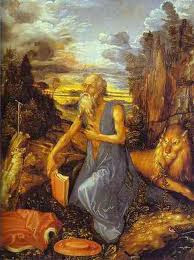
We most often see St. Jerome in art pictured in his ascetic monastic cell or in the desert, and he was very much attracted to the ascetic life, but spent a good part of his life in more courtly places, while continuing always to lead a simple monastic life.  He was ordained a priest in 378, but only received the honor with the stipulation that he not be appointed pastor of a church, as he felt his calling was to be a recluse, to live a monastic life.   He was a counsellor of Pope Damasas (Chair of Peter 366-384), serving as secretary of the council deciding over the problem of the schism in Antiochin the 380s.  Jerome aquitted his duties so well that the pope kept him in Rome as his own secretary, and set him in charge of "cleaning up" the copies of the New Testament and the Psalms which had suffered already by poor copying and translation. This was the beginning of St. Jerome's work on the Vulgate. 


In the 1890s, Pope Damasus having died, and having had enough of city life, St. Jerome moved to the Holy Land, making for himself a monastic cell outside of Bethlehem.  By the early 400s, he had completed his translation of the Bible, making his way through the Old Testament, even learning a new language (Chaldaic) in his scholarly pursuit of perfection.  By the time he had finished, St. Jerome had translated or "corrected" all the books of the Old and New Testament except the Books of Wisdom, Ecclesiasticus, Baruch, and the two Books of the Maccabees.    Leading always a life of purity and prayer, St. Jerome's God-given gift for languages and his knowlege and understanding of Sacred Scripture made him the ideal candidate for this undertaking of the Blessed Trinity.


*  St. Jerome is very often depicted with a lion and is associated with the medieval story in which the saint's charity in pulling a thorn from a lion's paw makes a pet of the lion.  In art, this Doctor of the Church usually has a lion reclining at his feet as he writes with a feather in a big book, indicating the Bible. Ther is, however, no mention of a pet lion in any of the multitudinous letters St. Jerome wrote in his lifetime, nor any other documentation of such an alliance.  It's believed that this story was transferred to St. Jerome from the tradition of St. Gerasimos, a monk also of the fifth century.  The confusion is easily forgiven, though, because a lion seems such an appropriate symbol for as strong and unflinching a champion of the Faith as St. Jerome.

St. Jerome died on September 30th, 420.  His relics lie in the Sistine Chapel in St. Mary Major Basilica in Rome.

Saturday, September 28, 2013

Saint of the Day - September 29
Saints Michael, Gabriel and Raphael

Angels—messengers from God—appear frequently in Scripture, but only Michael, Gabriel and Raphael are named.


Michael appears in Daniel's vision as "the great prince" who defends Israel against its enemies; in the Book of Revelation, he leads God's armies to final victory over the forces of evil. Devotion to Michael is the oldest angelic devotion, rising in the East in the fourth century. The Church in the West began to observe a feast honoring Michael and the angels in the fifth century
.
Gabriel also makes an appearance in Daniel's visions, announcing Michael's role in God's plan. His best-known appearance is an encounter with a young Jewish girl named Mary, who consents to bear the Messiah.
 
Raphael's activity is confined to the Old Testament story of Tobit. There he appears to guide Tobit's son Tobiah through a series of fantastic adventures which lead to a threefold happy ending: Tobiah's marriage to Sarah, the healing of Tobit's blindness and the restoration of the family fortune.

The memorials of Gabriel (March 24) and Raphael (October 24) were added to the Roman calendar in 1921. The 1970 revision of the calendar joined their feasts to Michael's.

Friday, September 27, 2013

Saint of the Day - September 28
St. Wenceslaus

He was born in 907 near Prague, son of the Duke of Bohemia. His saintly grandmother, Ludmilla, raised him and sought to promote him as ruler of Bohemia in place of his mother, who favored the anti-Christian factions. Ludmilla was eventually murdered, but rival Christian forces enabled Wenceslaus to assume leadership of the government.
His rule was marked by efforts toward unification within Bohemia, support of the Church and peace-making negotiations with Germany, a policy which caused him trouble with the anti-Christian opposition. His brother Boleslav joined in the plotting, and in September of 929 invited Wenceslaus to Alt Bunglou for the celebration of the feast of Sts. Cosmas and Damian (September 26). On the way to Mass, Boleslav attacked his brother, and in the struggle, Wenceslaus was killed by supporters of Boleslav.
Although his death resulted primarily from political upheaval, Wenceslaus was hailed as a martyr for the faith, and his tomb became a pilgrimage shrine. He is hailed as the patron of the Bohemian people and of former Czechoslovakia.
Saint of the Day - September 27
St. Vincent de Paul
The deathbed confession of a dying servant opened Vincent's eyes to the crying spiritual needs of the peasantry of France. This seems to have been a crucial moment in the life of the man from a small farm in Gascony, France, who had become a priest with little more ambition than to have a comfortable life.
It was the Countess de Gondi (whose servant he had helped) who persuaded her husband to endow and support a group of able and zealous missionaries who would work among poor tenant farmers and country people in general. Vincent was too humble to accept leadership at first, but after working for some time in Paris among imprisoned galley-slaves, he returned to be the leader of what is now known as the Congregation of the Mission, or the Vincentians. These priests, with vows of poverty, chastity, obedience and stability, were to devote themselves entirely to the people in smaller towns and villages.
Later, Vincent established confraternities of charity for the spiritual and physical relief of the poor and sick of each parish. From these, with the help of St. Louise de Marillac, came the Daughters of Charity, "whose convent is the sickroom, whose chapel is the parish church, whose cloister is the streets of the city." He organized the rich women of Paris to collect funds for his missionary projects, founded several hospitals, collected relief funds for the victims of war and ransomed over 1,200 galley slaves from North Africa. He was zealous in conducting retreats for clergy at a time when there was great laxity, abuse and ignorance among them. He was a pioneer in clerical training and was instrumental in establishing seminaries.
Most remarkably, Vincent was by temperament a very irascible person—even his friends admitted it. He said that except for the grace of God he would have been "hard and repulsive, rough and cross." But he became a tender and affectionate man, very sensitive to the needs of others.
Pope Leo XIII made him the patron of all charitable societies. Outstanding among these, of course, is the Society of St. Vincent de Paul, founded in 1833 by his admirer Blessed Frédéric Ozanam (September 7).

Wednesday, September 25, 2013

Saint of the - September 26
Sts. Cosmas and Damian


Nothing is known of their lives except that they suffered martyrdom in Syria during the persecution of the Emperor Diocletian.
A church erected on the site of their burial place was enlarged by the emperor Justinian. Devotion to the two saints spread rapidly in both East and West. A famous basilica was erected in their honor in Constantinople. Their names were placed in the canon of the Mass (Eucharistic Prayer I) , probably in the sixth century.
Legend says that they were twin brothers born in Arabia, who became skilled doctors. They were among those who are venerated in the East as the "moneyless ones" because they did not charge a fee for their services. It was impossible that such prominent persons would escape unnoticed in time of persecution: They were arrested and beheaded.

Nine centuries later, Francis of Assisi (October 4) rebuilt the dilapidated San Damiano chapel outside Assisi.

Tuesday, September 24, 2013

Saint of the day - 25 th September
Abadir and Iraja

Abadir and Iraja are legendary saints in the Coptic Church.
They are reported to have been children of the sister of Basilides, the father of kings. According to their legend, Abadir and Iraja fled from Antioch to Alexandria, were arrested there, brought to Antinoe, and beheaded there with 3,685 companions. These included the following priests:
  • Cluthus, a priest and physician of Antinoe;
  • Apa Paphnutius of Tentyra
  • Apa Isaac of Tiphre
  • Apa Shamul of Taraphia
  • Apa Simon of Tapcho
  • Sissinus of Tantatho
  • Theodore of Chotep
  • Moses of Psammaniu
  • Philotheus of Pemdje
  • Macarius of Fayum
  • Maximus of Vuchim
  • Macroni of Thoni
  • Senuthius of Buasti
  • Simeon of Thou
  • Ptolemaeus, son of the Eparch, and
  • Thomas of Tanphot.

Abadir and Iraja had a church dedicated to them in Osjut in Egypt. Their feast day is on September 25.