Thursday, October 3, 2013

Saint of the Day - October 4
St. Francis of Assisi
(1182-1226)

Francis of Assisi was a poor little man who astounded and inspired the Church by taking the gospel literally—not in a narrow fundamentalist sense, but by actually following all that Jesus said and did, joyfully, without limit and without a sense of self-importance.
Serious illness brought the young Francis to see the emptiness of his frolicking life as leader of Assisi's youth. Prayer—lengthy and difficult—led him to a self-emptying like that of Christ, climaxed by embracing a leper he met on the road. It symbolized his complete obedience to what he had heard in prayer: "Francis! Everything you have loved and desired in the flesh it is your duty to despise and hate, if you wish to know my will. And when you have begun this, all that now seems sweet and lovely to you will become intolerable and bitter, but all that you used to avoid will turn itself to great sweetness and exceeding joy."
From the cross in the neglected field-chapel of San Damiano, Christ told him, "Francis, go out and build up my house, for it is nearly falling down." Francis became the totally poor and humble workman.
He must have suspected a deeper meaning to "build up my house." But he would have been content to be for the rest of his life the poor "nothing" man actually putting brick on brick in abandoned chapels. He gave up all his possessions, piling even his clothes before his earthly father (who was demanding restitution for Francis' "gifts" to the poor) so that he would be totally free to say, "Our Father in heaven." He was, for a time, considered to be a religious fanatic, begging from door to door when he could not get money for his work, evokng sadness or disgust to the hearts of his former friends, ridicule from the unthinking.
But genuineness will tell. A few people began to realize that this man was actually trying to be Christian. He really believed what Jesus said: "Announce the kingdom! Possess no gold or silver or copper in your purses, no traveling bag, no sandals, no staff" (Luke 9:1-3).
Francis' first rule for his followers was a collection of texts from the Gospels. He had no idea of founding an order, but once it began he protected it and accepted all the legal structures needed to support it. His devotion and loyalty to the Church were absolute and highly exemplary at a time when various movements of reform tended to break the Church's unity.
He was torn between a life devoted entirely to prayer and a life of active preaching of the Good News. He decided in favor of the latter, but always returned to solitude when he could. He wanted to be a missionary in Syria or in Africa, but was prevented by shipwreck and illness in both cases. He did try to convert the sultan of Egypt during the Fifth Crusade.
During the last years of his relatively short life (he died at 44), he was half blind and seriously ill. Two years before his death, he received the stigmata, the real and painful wounds of Christ in his hands, feet and side.
On his deathbed, he said over and over again the last addition to his Canticle of the Sun, "Be praised, O Lord, for our Sister Death." He sang Psalm 141, and at the end asked his superior to have his clothes removed when the last hour came and for permission to expire lying naked on the earth, in imitation of his Lord.

Wednesday, October 2, 2013


Saint of the Day - October 3
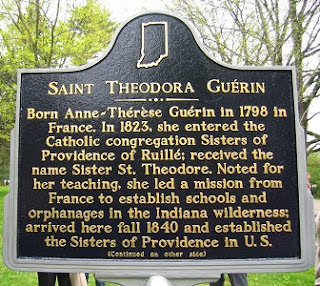
St. Theodora Guérin
(1798-1856)

Trust in God’s Providence enabled Mother Theodore to leave her homeland, sail halfway around the world and to found a new religious congregation.
Born in Etables, France, Anne-Thérèse’s life was shattered by her father’s murder when she was 15. For several years she cared for her mother and younger sister. She entered the Sisters of Providence in 1823, taking the name Sister St. Theodore. An illness during novitiate left her with lifelong fragile health; that did not keep her from becoming an accomplished teacher.
At the invitation of the bishop of Vincennes, she and five sisters were sent in 1840 to Saint Mary-of-the-Woods, Indiana, to teach and to care for the sick poor. She was to establish a motherhouse and novitiate. Only later did she learn that her French superiors had already decided the sisters in the United States should form a new religious congregation under her leadership.
She and her community persevered despite fires, crop failures, prejudice against Catholic women religious, misunderstandings and separation from their original religious congregation. She once told her sisters, “Have confidence in the Providence that so far has never failed us. The way is not yet clear. Grope along slowly. Do not press matters; be patient, be trustful.” Another time, she asked, “With Jesus, what shall we have to fear?”
She is buried in the Church of the Immaculate Conception in Saint Mary-of-the-Woods, Indiana, and was beatified in 1998. Eight years later she was canonized.

Tuesday, October 1, 2013

October 2
Feast of the Guardian Angels


Perhaps no aspect of Catholic piety is as comforting to parents as the belief that an angel protects their little ones from dangers real and imagined. Yet guardian angels are not only for children. Their role is to represent individuals before God, to watch over them always, to aid their prayer and to present their souls to God at death.
The concept of an angel assigned to guide and nurture each human being is a development of Catholic doctrine and piety based on Scripture but not directly drawn from it. Jesus' words in Matthew 18:10 best support the belief: "See that you do not despise one of these little ones, for I say to you that their angels in heaven always look upon the face of my heavenly Father."
Devotion to the angels began to develop with the birth of the monastic tradition. St. Benedict (July 11) gave it impetus and Bernard of Clairvaux (August 20), the great 12th-century reformer, was such an eloquent spokesman for the guardian angels that angelic devotion assumed its current form in his day.

A feast in honor of the guardian angels was first observed in the 16th century. In 1615, Pope Paul V added it to the Roman calendar.

Monday, September 30, 2013

Saint of the Day - October 1
St. Theresa of the Child Jesus
(1873-1897)

"I prefer the monotony of obscure sacrifice to all ecstasies. To pick up a pin for love can convert a soul." These are the words of Theresa of the Child Jesus, a Carmelite nun called the "Little Flower," who lived a cloistered life of obscurity in the convent of Lisieux, France. [In French-speaking areas, she is known as Thérèse of Lisieux.] And her preference for hidden sacrifice did indeed convert souls. Few saints of God are more popular than this young nun. Her autobiography, The Story of a Soul, is read and loved throughout the world. Thérèse Martin entered the convent at the age of 15 and died in 1897 at the age of 24.
Life in a Carmelite convent is indeed uneventful and consists mainly of prayer and hard domestic work. But Theresa possessed that holy insight that redeems the time, however dull that time may be. She saw in quiet suffering redemptive suffering, suffering that was indeed her apostolate. Theresa said she came to the Carmel convent "to save souls and pray for priests." And shortly before she died, she wrote: "I want to spend my heaven doing good on earth."
[On October 19, 1997, Pope John Paul II proclaimed her a Doctor of the Church, the third woman to be so recognized in light of her holiness and the influence of her teaching on spirituality in the Church.]

Her parents, Louis and Zélie, were bgeatified in 2008.

Sunday, September 29, 2013

Saint of the Day - September 30
St. Jerome

(345-420)


One of the first Doctors of the Church, St. Jerome  (c. 347 – 420) is widely known as the translator of the Bible into Latin (the Vulgate), but he was also the author of many other works.  He penned many letters and theological treatise, chiefly in defense of the Faith, arguing against the Arian heresy, rampant in his time, and defending the doctrine of the perpetual virginity of the Blessed Mother, as well a attacks against Christian pious practices, the cultus of martyrs and relics, the vow of poverty, and clerical celibacy.  After St. Augustine, St. Jerome is the most prolific writer of the ancient Christians. 
We most often see St. Jerome in art pictured in his ascetic monastic cell or in the desert, and he was very much attracted to the ascetic life, but spent a good part of his life in more courtly places, while continuing always to lead a simple monastic life.  He was ordained a priest in 378, but only received the honor with the stipulation that he not be appointed pastor of a church, as he felt his calling was to be a recluse, to live a monastic life.   He was a counsellor of Pope Damasas (Chair of Peter 366-384), serving as secretary of the council deciding over the problem of the schism in Antiochin the 380s.  Jerome aquitted his duties so well that the pope kept him in Rome as his own secretary, and set him in charge of "cleaning up" the copies of the New Testament and the Psalms which had suffered already by poor copying and translation. This was the beginning of St. Jerome's work on the Vulgate. 


In the 1890s, Pope Damasus having died, and having had enough of city life, St. Jerome moved to the Holy Land, making for himself a monastic cell outside of Bethlehem.  By the early 400s, he had completed his translation of the Bible, making his way through the Old Testament, even learning a new language (Chaldaic) in his scholarly pursuit of perfection.  By the time he had finished, St. Jerome had translated or "corrected" all the books of the Old and New Testament except the Books of Wisdom, Ecclesiasticus, Baruch, and the two Books of the Maccabees.    Leading always a life of purity and prayer, St. Jerome's God-given gift for languages and his knowlege and understanding of Sacred Scripture made him the ideal candidate for this undertaking of the Blessed Trinity.


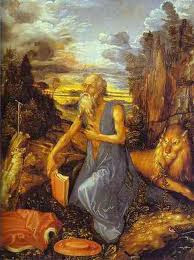
*  St. Jerome is very often depicted with a lion and is associated with the medieval story in which the saint's charity in pulling a thorn from a lion's paw makes a pet of the lion.  In art, this Doctor of the Church usually has a lion reclining at his feet as he writes with a feather in a big book, indicating the Bible. Ther is, however, no mention of a pet lion in any of the multitudinous letters St. Jerome wrote in his lifetime, nor any other documentation of such an alliance.  It's believed that this story was transferred to St. Jerome from the tradition of St. Gerasimos, a monk also of the fifth century.  The confusion is easily forgiven, though, because a lion seems such an appropriate symbol for as strong and unflinching a champion of the Faith as St. Jerome.

St. Jerome died on September 30th, 420.  His relics lie in the Sistine Chapel in St. Mary Major Basilica in Rome.

Saturday, September 28, 2013

Saint of the Day - September 29
Saints Michael, Gabriel and Raphael

Angels—messengers from God—appear frequently in Scripture, but only Michael, Gabriel and Raphael are named.


Michael appears in Daniel's vision as "the great prince" who defends Israel against its enemies; in the Book of Revelation, he leads God's armies to final victory over the forces of evil. Devotion to Michael is the oldest angelic devotion, rising in the East in the fourth century. The Church in the West began to observe a feast honoring Michael and the angels in the fifth century
.
Gabriel also makes an appearance in Daniel's visions, announcing Michael's role in God's plan. His best-known appearance is an encounter with a young Jewish girl named Mary, who consents to bear the Messiah.
 
Raphael's activity is confined to the Old Testament story of Tobit. There he appears to guide Tobit's son Tobiah through a series of fantastic adventures which lead to a threefold happy ending: Tobiah's marriage to Sarah, the healing of Tobit's blindness and the restoration of the family fortune.

The memorials of Gabriel (March 24) and Raphael (October 24) were added to the Roman calendar in 1921. The 1970 revision of the calendar joined their feasts to Michael's.

Friday, September 27, 2013

Saint of the Day - September 28
St. Wenceslaus

He was born in 907 near Prague, son of the Duke of Bohemia. His saintly grandmother, Ludmilla, raised him and sought to promote him as ruler of Bohemia in place of his mother, who favored the anti-Christian factions. Ludmilla was eventually murdered, but rival Christian forces enabled Wenceslaus to assume leadership of the government.
His rule was marked by efforts toward unification within Bohemia, support of the Church and peace-making negotiations with Germany, a policy which caused him trouble with the anti-Christian opposition. His brother Boleslav joined in the plotting, and in September of 929 invited Wenceslaus to Alt Bunglou for the celebration of the feast of Sts. Cosmas and Damian (September 26). On the way to Mass, Boleslav attacked his brother, and in the struggle, Wenceslaus was killed by supporters of Boleslav.
Although his death resulted primarily from political upheaval, Wenceslaus was hailed as a martyr for the faith, and his tomb became a pilgrimage shrine. He is hailed as the patron of the Bohemian people and of former Czechoslovakia.